

If you checked the recent form of both teams before the match, you would have thought this might be a one-sided thrashing by Arsenal.
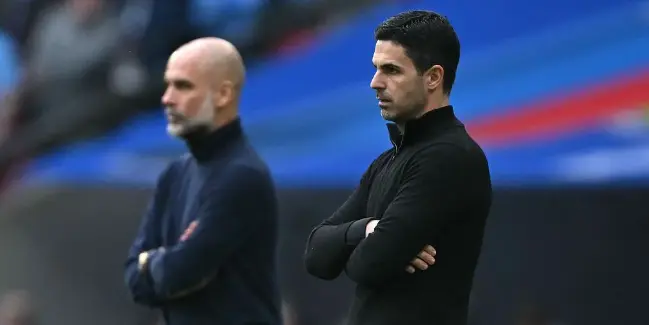
Manchester City had just been eliminated by Real Madrid 5-1 on aggregate in the Champions League and then held to a draw by West Ham United in the league. Meanwhile, Arsenal were on a 14-match unbeaten run, had advanced to the Champions League quarter-finals with their heads held high, and were sitting comfortably at the top of the Premier League table—fans were even discussing the feasibility of a quadruple. Furthermore, Arsenal had a record of 3 wins, 3 draws, and 4 losses in their last 10 matches against Manchester City, with Mikel Arteta clearly having gained some insights into how to defeat his mentor Pep Guardiola.
If you only watched the first 10 minutes, you would still have thought this would be a massacre by Arsenal.
In the 5th minute, Kai Havertz played a cutback, but Kai Havertz committed a foul while attempting a shot. In the 7th minute, Martin Zubimendi's through ball triggered a series of attacks, but unfortunately Havertz remained the same player who struggles with one-on-ones, gifting James Trafford a hat-trick of saves.
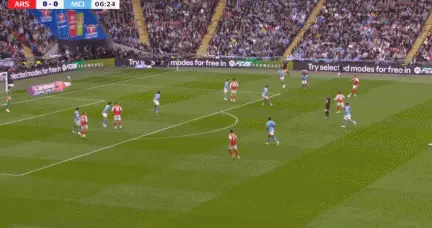
And then, nothing else happened.
We all know that although Arsenal have achieved excellent results this season, they have been playing extremely pragmatic football. Their typical approach is to place a target man up front, stack ball-winners in midfield, exchange tackling counts for attacking transitions, and focus solely on using physicality to win set-pieces. The advantage of this style is its extremely high margin for error—coupled with set-piece tactics, you really don't lose easily in the league. However, the disadvantage is that Arsenal are gradually losing the ability to organize normal attacks; once they fall behind, they collapse completely.
Having seen through this, Guardiola neutralized Arsenal's attack with three moves:
A. Dissect the midfield. Rodri pushed forward to mark Zubimendi, while Bernardo Silva cut off Declan Rice's receiving lines, resulting in Zubimendi completing 70% of his passes in his own half throughout the match. Rice carried the ball forward 15 times, but after offsetting forward and backward progress, his total net forward distance was only 3 meters.
B. Surround Havertz and force Arsenal's attacks wide. Whoscored statistics showed that Havertz only touched the ball 9 times in the first half—the fewest of any player on the pitch.
C. When seeing Arsenal's sporadic threatening attacks, commit fouls in advance to push set-pieces to around the center circle.
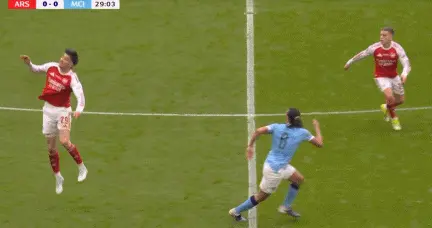
As a result, Arsenal's midfield made no forward progress, there was no center-forward connection in the final third, and the only way to move the ball forward was through the wingers. However, Leandro Trossard is not a game-breaking player, and Bukayo Saka... he has been mentally preparing for the World Cup since a month ago.
In fact, Arsenal have encountered this situation many times this season. They usually pass the ball around at the back to draw the opponent into pressing, thereby relieving pressure on the middle and final thirds. But Manchester City didn't press at all in this match—they knew full well that Arsenal's build-up play structure is extremely fragile. Their center-backs are not comfortable on the ball, and their key playmakers from the back are Jurriën Timber and David Raya, neither of whom were available for this game.
Thus, an awkward scene unfolded where Kepa Arrizabalaga wandered around in his penalty area for a long time without anyone pressing him... It's not that Arsenal didn't try hard, but their former manager read Arteta's mistakes aloud right in front of him.
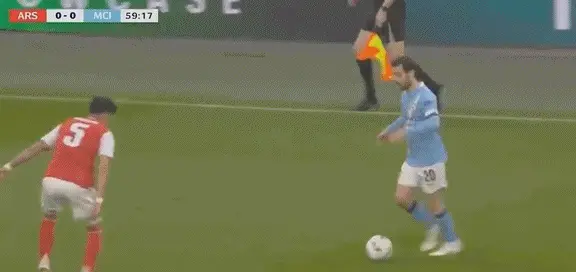
Of course, after implementing these countermeasures, Manchester City gave up high pressing and some of Bernardo Silva and Rodri's attacking involvement. Nevertheless, they still had two powerful wingers. Jeremy Sarmiento dominated Piero Hincapié, while Jérémy Doku attracted multiple defensive players on his side.
Like this 2 GIF:
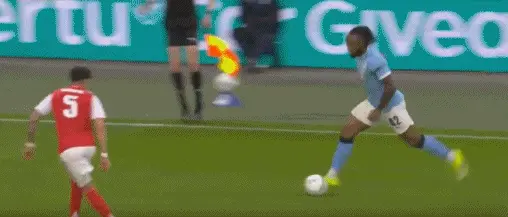
Under the constant attacks from the two wingers plus Cherki, Arsenal's tactic of using center-backs as full-backs quickly exposed its lack of mobility. In the second half, Arsenal's defense gradually loosened. In the 60th minute, Cherki crossed from the byline, and Kepa made a volleyball-style double-fisted clearance that accurately teed up Nico O'Reilly at the far post…
Arsenal fans familiar with Kepa know this truth: sometimes, you don't need to worry about being lazy, because when you do try hard, you never know what kind of disaster you might cause.
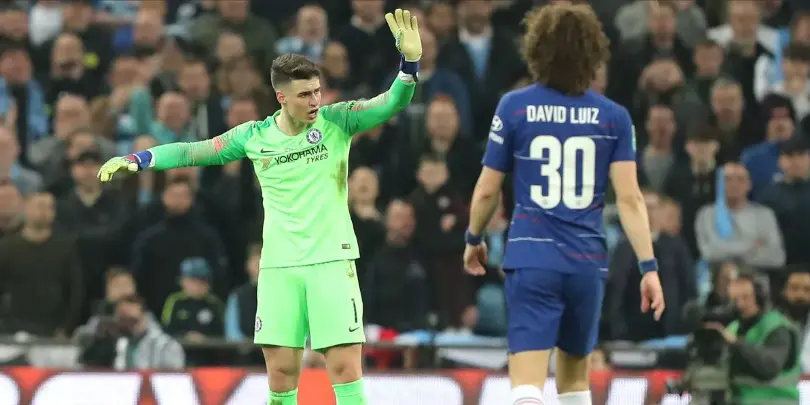
- In the 2019 League Cup final, Kepa refused to be substituted during the penalty shootout, and Chelsea lost the shootout.
- In the 2022 League Cup final, he missed a penalty in the shootout, and Chelsea lost again.
- In the 2026 League Cup final, his mistake while collecting a cross led to Manchester City's opening goal.
- Before Kepa could recover, another blow came three minutes later. Nunes crossed, still O'Reilly, still a header, Manchester City led 2-0.
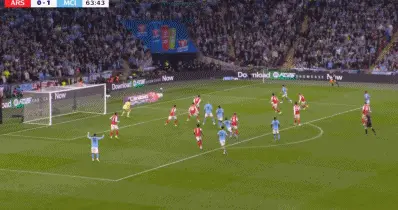
In fact, Manchester City's current squad has obvious flaws. Their defenders are average in aerial duels, and defending crosses is a clear weakness. But the problem is that Arsenal didn't create a single header attempt from open play throughout the match. When you can't even get the ball into the penalty area, it doesn't matter how good or bad the opponent's aerial defense is.
Unfortunately, Guardiola understands Arsenal's current systemic problems perfectly. The four center-backs—Ben White, William Saliba, Gabriel Magalhães, and Piero Hincapié—lined up in a row certainly look impenetrable, but this comes at the cost of attacking capabilities from the flanks... This style of play was mastered by Guardiola during Manchester City's Champions League-winning season, but their attacking creativity was supported by four number 10s: Jack Grealish, Bernardo Silva, Kevin De Bruyne, and Phil Foden.
However, even after leaving his mentor for many years, Arteta is still copying Guardiola's tactics.

Therefore, when trailing 0-2, Arsenal seemed to be parking the bus, but it was actually a "want to press but can't" bus. The midfield was completely out of control, the ball couldn't reach the final third, Manchester City won all the second balls, and Arsenal couldn't regain possession at all.
In the 65th minute, Madueke and Calafiori came on, replacing Hincapié and Havertz. In the 78th minute, Calafiori volleyed against the post—the closest Arsenal came to scoring all match. For the remaining time, Arsenal seemed to be waiting for a miracle, but the prerequisite for a miracle is that you must have effective attacking methods.
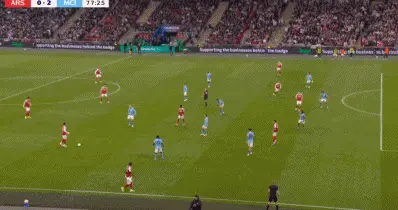
But Arsenal don't have any at the moment. The tactics on Arteta's clipboard are like automated assembly lines that break down against strong opponents.
—After going 2-0 up, Manchester City started passing the ball around at the back, showing off various skills and playing tricks around the center circle.
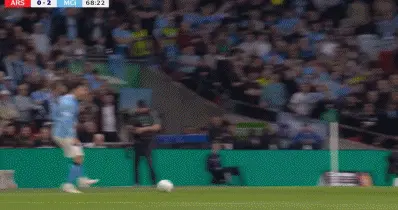
In the 68th minute, Cherki juggled the ball in Arsenal's defensive third…
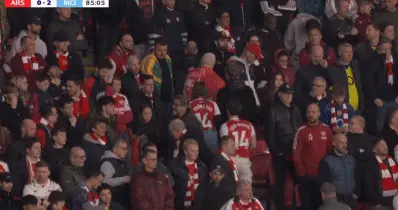
In the 85th minute, when the camera panned to the Arsenal fans who left early, there was no anger on their faces, only a calm expression of “it was to be expected.”
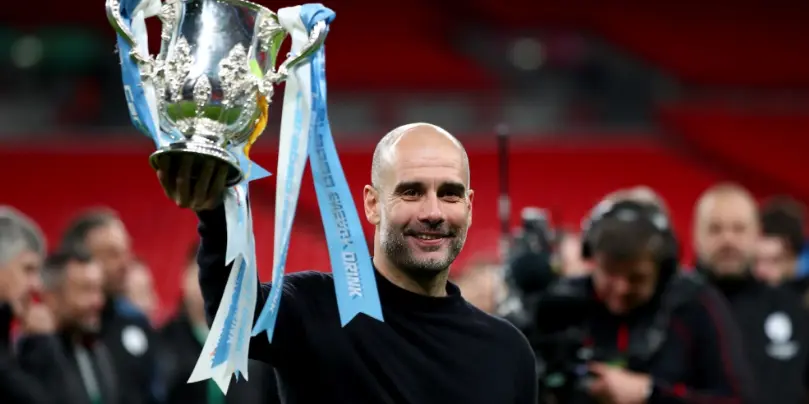
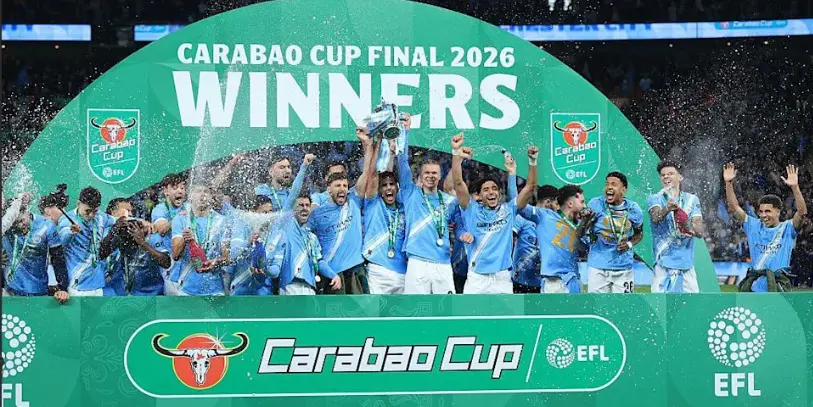
In the end, Manchester City won 2-0 to lift the League Cup, making Guardiola the first manager in history to win the League Cup five times. The last time Arsenal lifted the League Cup at Wembley was back in 1993. That year, Manchester City were playing in the old First Division, Arsène Wenger hadn't left Monaco yet, and Mikel Arteta had just turned 11.
The League Cup may not be a major trophy, but it is enough to reflect Arteta's biggest problem. He pursues perfect defense too much, thus creating a system with an extremely high floor but an equally low ceiling. The current issue is that the entire team has become accustomed to this defensive-oriented rhythm. When they really need to implement normal attacking patterns, even if they bring on a group of attacking players, they can't suddenly start playing attacking football effectively.
Arteta thinks he's stuck at the end, but in reality, he's stuck at the beginning.
His attacking system is like a roll of transparent tape—before using it, you must first distinguish the correct direction with at least two precise rotations, clockwise and counterclockwise. Even if a god came... they would have to feel around for a while to find the starting point.