

According to media reports, a cross-party group of MPs has called on FIFA to consider expelling the United States from the World Cup until the country demonstrates a clear commitment to abiding by international law and respecting the sovereignty of other nations.
The move stems from the US military’s raid on Caracas, the capital of Venezuela, this month to arrest the country’s leader Nicolás Maduro, as well as recent warnings issued by US President Donald Trump to several other countries.
With the US set to co-host both the World Cup and the Olympic Games in the next two and a half years, questions have been raised about the problems US foreign policy may pose for sports organisations and whether any body will take a stance.
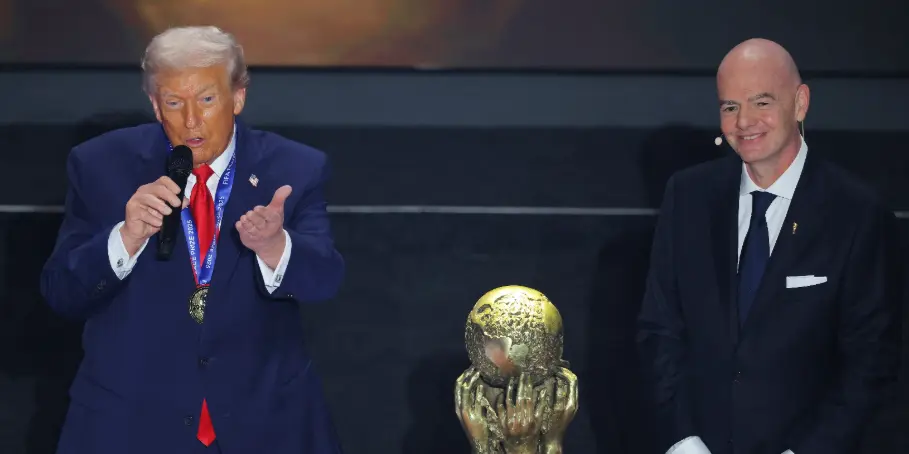
As early as last December, FIFA awarded Trump its first Peace Prize at the 2026 World Cup draw ceremony in Washington, citing his "key role" in brokering the Israeli-Palestinian ceasefire, advancing peace and seeking to end other conflicts.
In the weeks since, the US has launched military operations in Venezuela and Nigeria, and hinted at further action in Greenland, Mexico (a joint World Cup host), and two other participating nations – Colombia and Iran.
Currently, 25 politicians from the Labour Party, Liberal Democrats, Green Party and Plaid Cymru have jointly signed a parliamentary motion calling on international sports bodies to consider expelling the US from major international events, including the World Cup. They stated that such events "should not be used to legitimise or normalise the violations of international law by powerful states".
The MPs expressed concern over the "escalation of US actions against Venezuela", including the "kidnapping of President Nicolás Maduro", claiming these acts constituted a "direct interference in the internal affairs of a sovereign state".
Their motion also noted "repeated veiled and public threats by senior US officials against Denmark, Colombia and Cuba", describing them as "undermining the rules-based international order".
While the White House has not yet responded to the Reporter on the MPs’ motion, it previously claimed the arrest of Maduro was a law enforcement operation targeting an illegitimate leader involved in drug smuggling and terrorism, with Trump stating the US will now take control of Venezuela and its oil industry.
Maduro insists he is a prisoner of war, and Trump faced fierce criticism at an emergency UN Security Council meeting. UN Secretary-General António Guterres said he was "deeply concerned that the rules of international law were not respected during the US operation".
Meanwhile, Trump has warned Cuba to "make a deal" over Venezuelan oil exports or "it will be too late", and stated that a military operation against Colombia "sounds good".
Similar to his stance on Venezuela, Trump accused Colombia of doing too little to combat drug smuggling. Colombian President Gustavo Petro told the Reporter he believed there was a "real threat" of US military action against his country.
Trump also claimed that drugs are pouring into the US from Mexico "in massive amounts", adding that "we have to act", with reports stating he has begun planning to deploy US military forces.
Mexican President Claudia Sheinbaum has rejected any suggestion of US military action on Mexican soil.
Trump also insisted that the US needs to take over Greenland for national security reasons, and did not rule out the use of force. He announced new tariffs on eight European allies that opposed his takeover proposal.
This mineral-rich Arctic territory is controlled by Denmark, a NATO member, whose national team could also qualify for the World Cup via play-offs.
The Trump administration also faces increasing scrutiny over the legality of air strikes on suspected drug-smuggling vessels in the Caribbean and the Eastern Pacific.
FIFA declined to comment on the MPs’ motion, and there is no sign it will reconsider its annual Peace Prize award. But few believe it will take action against the country hosting most of the World Cup matches, particularly given the close relationship between the organisation’s president Gianni Infantino and Trump.
This relationship has sparked accusations that FIFA has become politicised, despite its insistence that it has a legal duty to remain neutral as a football governing body.
This is not the first time FIFA has faced pressure over the political actions of a World Cup host nation. In 2018, the World Cup was held in Russia despite its annexation of Crimea four years earlier. Russia has also been accused of launching cyberattacks, interfering in Western elections, and carrying out the Novichok nerve agent attack in Salisbury.
However, some have drawn parallels with FIFA’s decision to ban Russia from international competition after its full-scale invasion of Ukraine in 2022 – a sanction that remains in place to this day.
When asked about the US action in Venezuela, Brian Leishman, one of the MPs who signed the motion, told the Reporter: “Let’s be consistent. This is an invasion of a sovereign state and the kidnapping of the Venezuelan president. Let me be clear: I am a fierce critic of Maduro, but what we are seeing is a blatant disregard for international law. Look at how Russia was treated – the ban on Russia was absolutely the right thing to do, and I simply want the same consistency in punishment for the US.”
Sources within FIFA have privately noted that the Russian Football Union remains a member association, and that the ban on its participation in international matches stems more from other teams refusing to play against Russia and security concerns, rather than a moral stance taken by FIFA.
A glimpse into FIFA’s stance came last October, when Infantino, facing pressure to sanction Israel, stated that FIFA "cannot solve geopolitical problems". This followed a UN inquiry commission’s conclusion that Israel had committed genocide against Palestinians in Gaza. The Israeli Foreign Ministry rejected the report in its entirety, condemning it as "distorted and false".