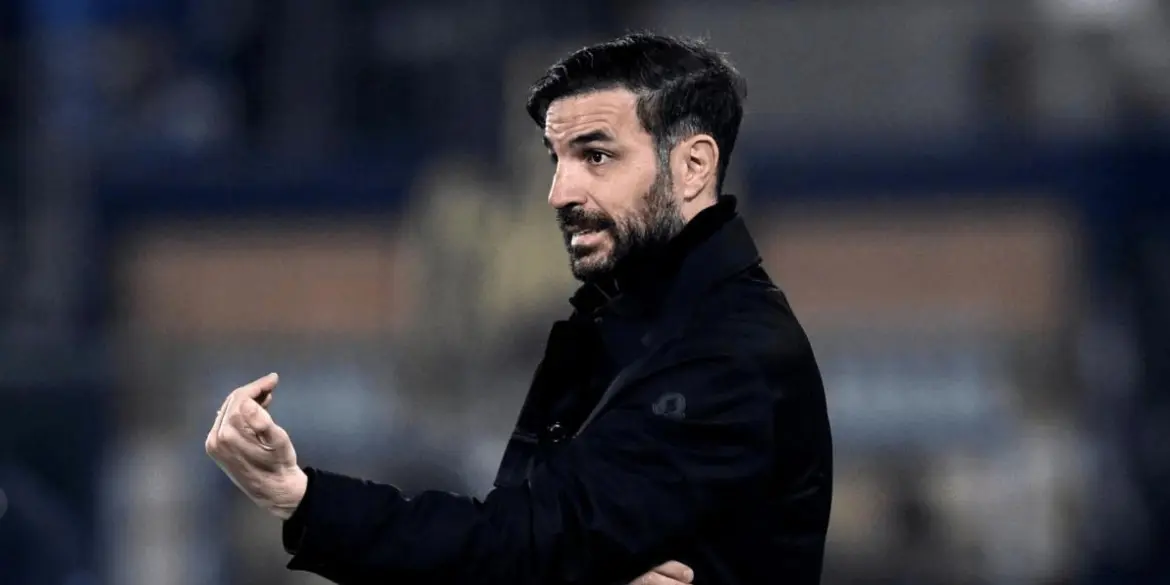



Recently, former Barcelona, Chelsea and Arsenal player, now Como manager Cesc Fàbregas, was interviewed by Camel Live. He talked about the differences between modern players and those from his era, as well as the distinctions between his identity as a coach and his past career as a player.
Fabregas: Young players nowadays need constant attention to make them understand what kind of life they should lead.
Host: Do you think they need more guidance than players did in your era?
Fabregas: They have access to far more information, but they need to reflect repeatedly and remember that to become top players, they have to eat well, stay prepared and stay focused.
Because these days, when you sign players from other teams—wingers, for example—they come in and don’t track back. Or they play well for ten minutes, then you don’t see them for the next thirty; their performance lacks consistency. One day they make a mistake, and it feels like the end of the world—they are so afraid of failure.
Host: Do you think this is because they feel constantly exposed to public scrutiny?
Fabregas: That could be it. Or maybe it’s because when they were young, they were told they were exceptional. Some players come from top youth academies, where they were used to winning 10-0, used to success and being praised. Now they come here, or go elsewhere, where the level is higher, and they need to perform well every week. Or, like us now, every three days. They struggle. You have to keep pushing them to understand that to be elite, they need to set the bar as high as possible.
Host: You came through La Masia and Arsenal. Do you think the football education your generation received was different?
Fabregas: Yes, it was a bit stricter. But at the same time, I always say I was very lucky in my early career. Because at 16, growing up at Arsenal, I had Thierry Henry, Patrick Vieira, Robert Pires, Sol Campbell, Martin Keown, Ray Parlour, Dennis Bergkamp. That was an incredible team, wasn’t it? If I made any mistake, don’t worry, I’d be told straight away. That helped me a lot.
Host: Henry was very straightforward, wasn’t he?
Fabregas: I loved that about him. He was very direct. But always in a good way, because he wanted you to be the best. I felt well looked after. They were blunt, but they always showed me the right path. They led by example, demonstrating how to behave on the pitch.
No one explicitly told me this, but I could sense that if these unbeatable, highly accomplished people did things this way, then this was the right way. So I had to follow their lead. Thank God I listened—they were my best role models.
Nowadays in football, people don’t trust young players as much, because coaches feel that once they make a mistake, they’ll be written off.
That’s why I’m so grateful to be part of a project like ours, because we have clear goals, we know what kind of team we want to be, and we know exactly how to handle young players.
Host: As a player and as a coach, how does your feeling of success differ?
Fabregas: That’s a good question. Everything about managing is completely different from playing. As a player, you’re younger, and what people say about you has a bigger impact—positive or negative—and sometimes you don’t want to hear it. My experience now is that you have to listen to everything—not the media noise, not the criticism, but the people around you. As a player, I think it affected me more. But now as a coach, I’m much more relaxed.
Host: Do you need to be liked by the players? Liked by the players?
Fabregas: Yes, to a certain extent. Of course, it’s impossible to be liked by all 25 players—that’s unrealistic. I wish there was a solution, like a magic potion or something, but there isn’t. So you have to convince the players. That’s what we’re doing—making them believe in you.
Yes, they need to trust that what we’re doing, the direction we’re working towards, is right. That it will lead to success in the future.
Tactics are very important as a coach. I’m obsessed with tactics. I do a lot of work, but convincing people and finding ways to make all the players feel that what we’re doing makes sense—that’s the most important thing, I think. Because I always say, if one player doesn’t believe, it becomes two, then three, because negative vibes in the dressing room spread quickly. You have to be very careful.