

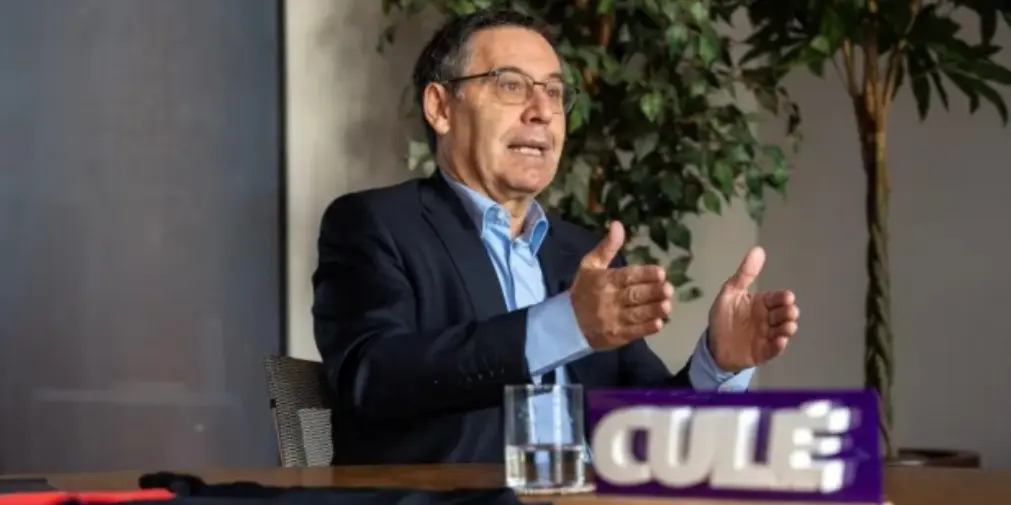
In an interview with Culemanía, former Barcelona president Josep Maria Bartomeu spoke about a club that once attempted to pay Lionel Messi's €400 million release clause.
Do you regret paying exorbitant transfer fees for players like Philippe Coutinho and Ousmane Dembélé?
Bartomeu: Yes, the market was inflating rapidly back then. As I've said before, Premier League clubs and those controlled by state capital broke the market. The €222 million release clause they paid for Neymar was already a huge amount, and then rumors started that a club wanted to pay €400 million for Messi's release clause. Football was becoming bloated. Other clubs were also making big signings at high prices, and then everything suddenly collapsed.
Who are you referring to? Which club wanted to pay €400 million for Messi?
Bartomeu: There was one club that made a move in 2017, after Messi's wedding. It was said that a club was trying to raise €400 million to pay his release clause and take him away.
Was it Paris Saint-Germain or Chelsea?
Bartomeu: I don't know. I don't know the name, and I won't say it now because they would deny it. But this did force us to renew Messi's contract to increase his release clause, which we raised to €700 million to avoid temptation from other clubs.
Some signings succeeded, others failed. Do you think your biggest management mistake as Barcelona president was the soaring wage bill?
Bartomeu: In 2017, coinciding with Neymar's departure, several players had expiring contracts, one of whom was Messi. We renewed his contract then—I remember he had a year and a half left on his current deal. We renewed it to increase the release clause to €700 million. Why? Because we didn't want other clubs interfering. We also increased the release clauses for Jordi Alba and Sergio Busquets. With each contract renewal, salaries were matched to the release clauses.
But the story you mentioned about someone wanting to pay €400 million for Messi refers to the release clause value. Was that before or after Neymar left?
Bartomeu: After that. After Neymar went to Paris for €222 million, there were rumors, and we also had information that a club was...
I assume it wasn't Paris because they had already spent €222 million on Neymar and later €180 million on Kylian Mbappé, totaling around €400 million—they couldn't possibly pay another €400 million for Messi.
Bartomeu: No, no. I didn't say it was Paris. The rumors about Messi were from a different club. They were prepared to pay €400 million for Messi's release clause after Neymar had already left Barcelona. So we talked to Leo and his family, renewed the contract, and increased the release clause to €700 million. Obviously, this also had an impact.
The wage bill increased. The parameters we followed weren't much higher in percentage terms than the targets we were pursuing based on our growing revenue, and the club could afford it. I always say the same thing: yes, salaries went up, but the club could afford them. What happened was that during the pandemic, the club couldn't afford them anymore. If we had known there would be a pandemic, obviously, we wouldn't have signed such contracts for those few players.
We've talked a lot about Messi. I want to ask you, do you still keep in touch with him today?
Bartomeu: With Leo, I was in contact more when he was in Paris. We sent messages occasionally. When he won the World Cup, I sent him a congratulatory message. I worked with him for many years. I started in 2003, when I was on the board of directors, and Leo was already at the club. Then from 2010 to 2020, I worked alongside him for 10 years.
Now that he's in Miami, we haven't been in contact. I haven't spoken to him, but I will go see him in the near future because I'll be in the United States in mid-April, and I'll go watch some Inter Miami games. Don't forget we have many friends there: Xavi Asensi, who was once part of my commercial team; Raúl Sanllehí, who worked in Barcelona's professional football team; and Víctor Ribas, who was once the head of ticketing at our stadium.
I asked you about Messi because when you resigned, it felt like your relationship with Leo didn't end well. Especially three months before that, you had to deal with that famous fax, which coincided with Luis Suárez leaving to join Atlético Madrid.
Bartomeu: Yes. After the painful defeat in the Champions League in Lisbon, we did what we should have done a year earlier—started renewing the team. That team achieved great success from 2008 to 2020, winning countless trophies. 2020 was the only year without any silverware, and we began the renewal process.
Ronald Koeman accepted the challenge, started refreshing the team, letting go of players who were no longer needed and bringing in young players. In fact, Koeman had already started promoting players from Barça B to the first team and letting go of some established players like Luis Suárez or Ivan Rakitić that summer. That was the beginning of that renewal process. Then, Messi did send that fax. I don't know the exact reason he wanted to leave. If you say it was about Suárez, I don't know.
At least the timing matches.
Bartomeu: The timing matches, but I don't know the specific factors. But Messi had a contract with one year remaining, and he was a key player for the club—not just on the pitch, but economically as well. So it was impossible for us to give him a free transfer. No club made an offer for him either, but giving Messi a free transfer to let him go to another club was out of the question.
If the situation had been different, it might have been like Xavi or Andrés Iniesta, who wanted to play in Japan or Qatar. But at that time, Barcelona needed Messi. He was a crucial part of the club's sports project. He was also the most important player for Koeman, so we told him he couldn't leave, and he continued working and playing.
So after that tense situation, would you say your relationship with Messi improved?
Bartomeu: Well, my relationship with Messi was never bad. Of course, the tension passed because Messi started that season with Koeman and the young players and won a Copa del Rey, which was earned through hard work and excellent performances. With the arrival of new young players, the future was full of hope. Then Xavi continued the team's renewal process, bringing in more young players while some veterans left the club.
Did you talk to Messi after he left Barcelona and Joan Laporta became president?
Bartomeu: Yes, I did. We spoke several times when he was at Paris Saint-Germain. But since he's been in Miami, we haven't... haven't spoken, but I know how he's doing because, as I said before, I have good friends in Miami. I know things are going very well. They're happy, and the team's asset value and sporting value have both increased. I think that's thanks to Messi's arrival.
But did Messi ever say anything to you about his departure from Barcelona?
Bartomeu: I keep the content of our conversations private. But he wasn't happy at the time because he really wanted to stay at the club and would have done everything to stay and adapt to the economic situation caused by the pandemic.