


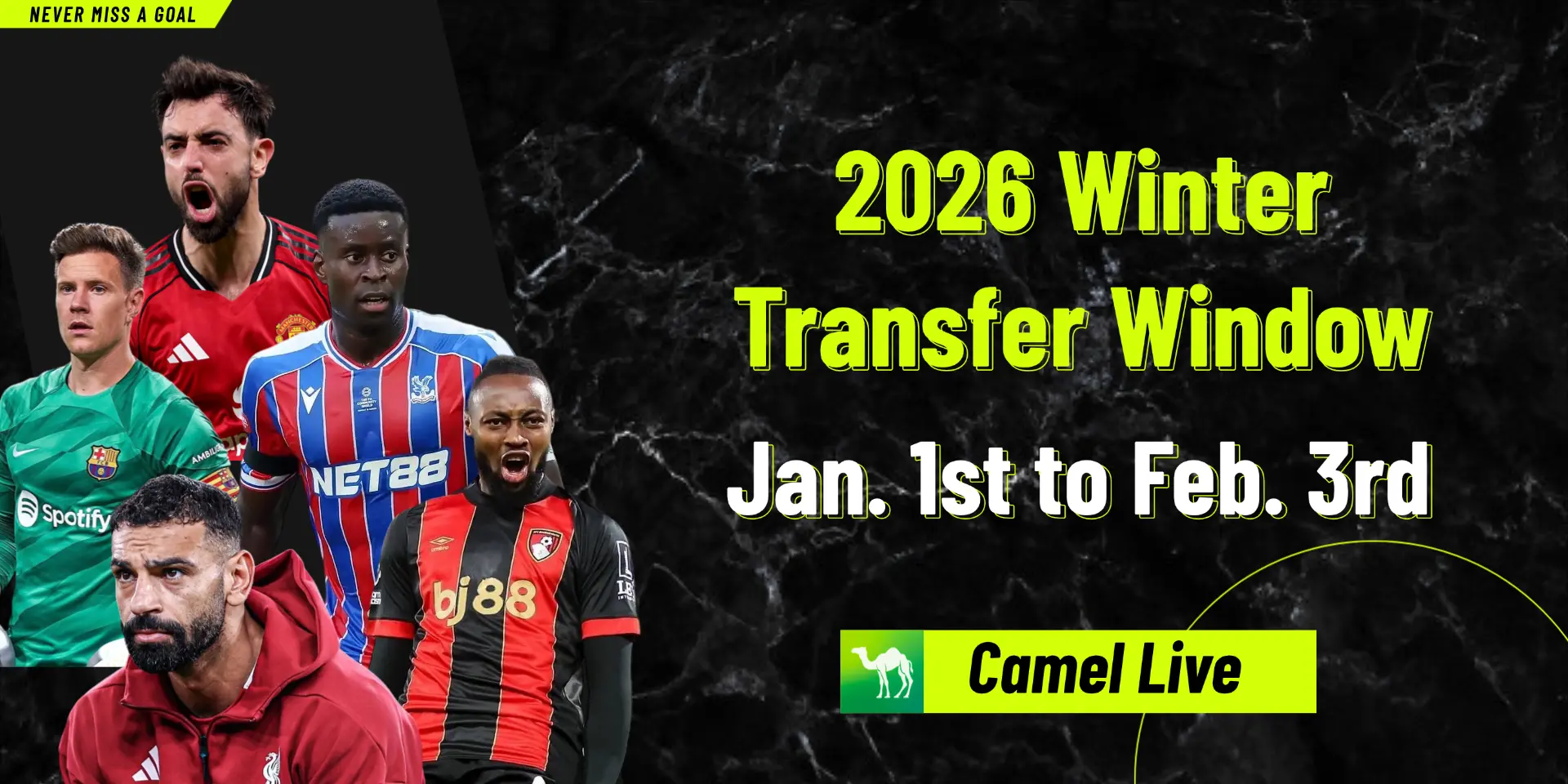
As the 2026 winter transfer window slammed shut across Europe’s top leagues in the early hours of February 3, the final spending figures and blockbuster deals have laid bare a stark reality: football’s financial landscape is more imbalanced than ever, with Manchester City leading a Premier League spending spree that has left rival leagues trailing in its wake. Combining squad reinforcement rankings and top player transfer fees data, this analysis unpacks the window’s biggest stories, controversies and seismic shifts.
👉 Skip the endless tweet-scrolling & news-hoppingOne page = your entire winter transfer hub
👇 Check it out
🐫 Camel Live Winter Transfer Special Page

1. Team Spending Rankings: Man City, Al-Hilal and Crystal Palace Break Away at the Top
The final club expenditure rankings, compiled by Camel Live, reveal a three-horse race at the summit of winter spending, with Manchester City, Al-Hilal SFC and Crystal Palace establishing a massive gap over the rest of the pack .
- Manchester City (£95m): The Premier League champions topped the charts with a targeted spending spree, securing Bournemouth winger Antoine Semenyo for £64m and Crystal Palace centre-back Marc Guéhi for a bargain £20m. The moves underscore City’s dual strategy: shoring up short-term title chances while planning for defensive succession with the 24-year-old Guéhi.
- Al-Hilal SFC (£91.72m): The Saudi Pro League giants proved they are no longer just a retirement home for European stars, splashing out on a mix of elite talent and rising prospects, including £30m for Rennes midfielder Martin Terrier and £25m to lure Karim Benzema from rivals Al-Ittihad. Their spending spree has reignited debates about the Gulf state’s growing influence on global football.
- Crystal Palace (£89.7m): In the window’s biggest surprise, the Eagles emerged as aggressive buyers, shelling out £49.7m for Wolves striker Jørgen Strand Larsen and £40m for Tottenham winger Brennan Johnson. The club’s bold investment—equivalent to Inter Milan’s entire 2025 Serie A title-winning budget—has left fans and pundits questioning whether this is a calculated gamble or a reckless financial stretch.
Notably, the Premier League dominated the top 10 rankings, with five teams (Man City, Crystal Palace, Tottenham, West Ham, Bournemouth) securing spots—a testament to the league’s unparalleled financial muscle. By contrast, La Liga’s highest entrant was Atletico Madrid at No.8 (£38m), while Serie A’s Lazio scraped in at No.10 (£36.55m).
| Club | Transfer Fee (Million Euros) |
|---|---|
| Manchester City | 95.00 |
| Al Hilal | 91.72 |
| Crystal Palace | 89.70 |
| Tottenham Hotspur | 55.00 |
| West Ham United | 54.30 |
| Flamengo | 53.70 |
| Bournemouth | 42.00 |
| Atletico Madrid | 38.00 |
| Fenerbahce | 37.00 |
| Lazio | 36.55 |

2. Player Transfer Fees: Semenyo Claims the Crown, Deadline Day Frenzy Delivers Larsen
The individual transfer fee rankings paint a picture of a window defined by high-value wingers and strikers, with Antoine Semenyo emerging as the undisputed record breaker .
- Record Signing: Antoine Semenyo (£64m): The Bournemouth winger’s move to Manchester City is the most expensive deal of the winter, making him the Premier League champions’ marquee addition to boost their attacking depth amid a congested title and Champions League run.
- Deadline Day Splash: Jørgen Strand Larsen (£49.7m): Crystal Palace pulled off the window’s most dramatic late deal, securing the Wolves striker for an initial £43m plus £6.7m in add-ons. The signing, completed hours before the deadline, was the linchpin of Palace’s attacking overhaul, designed to replace Jean-Philippe Mateta (whose move to AC Milan was derailed by knee injury concerns).
- Other Standout Deals: Lucas Paqueta’s £42m exit from West Ham to Flamengo was the biggest outgoing transfer, while Conor Gallagher’s £40m switch from Atletico Madrid to Tottenham and Ademola Lookman’s £40m move to Atletico highlighted the Premier League’s two-way traffic in elite midfield talent.
The window also saw a flurry of mid-tier deals, with West Ham splashing £29m on Lazio striker Taty Castellanos and £23m on Gil Vicente defender Pablo Felipe in a desperate bid to avoid relegation.
| Rank | Player Name | Position | Club | Transfer Fee (Million Euros) |
|---|---|---|---|---|
| 1 | Antoine Semenyo | Right Winger | Man City | 72.00 |
| 2 | Jørgen Strand Larsen | Centre-Forward | Crystal Palace | 49.70 |
| 3 | Lucas Paquetá | Attacking Midfield | Flamengo | 42.00 |
| 4 | Conor Gallagher | Central Midfield | Tottenham | 40.00 |
| 5 | Brennan Johnson | Right Winger | Crystal Palace | 40.00 |
| 6 | Ademola Lookman | Second Striker | Atlético Madrid | 35.00 |
| 7 | Oscar Bobb | Right Winger | Fulham | 31.20 |
| 8 | Kader Meïté | Centre-Forward | Al-Hilal | 30.00 |
| 9 | Taty Castellanos | Centre-Forward | West Ham | 29.00 |
| 10 | Rayan | Centre-Forward | Bournemouth | 28.50 |
3. Premier League’s Financial Dominance: A Two-Tiered System Takes Shape
The winter window’s spending patterns have laid bare the Premier League’s financial hegemony—a gap that is only widening year on year. Five English clubs in the top 10 spending list is no coincidence; it is a product of the league’s astronomical broadcast revenue, which dwarfs that of its European rivals .
As fans pointed out in post-window discussions, the financial gap is staggering: the Premier League’s bottom-placed team earns over £110m in broadcast revenue annually—more than Serie A champions Inter Milan’s £95m title-winning budget and even surpassing the broadcast income of La Liga’s third-placed Atletico Madrid. This revenue advantage allows even mid-table clubs like Crystal Palace to spend like traditional European giants, creating a self-reinforcing cycle: more spending leads to better competitiveness, which drives higher broadcast deals, and so on.
The consequences are clear for other leagues. La Liga and Serie A clubs are increasingly forced to sell their best talent to the Premier League to balance the books, with Atletico Madrid’s sale of Gallagher to Tottenham and Lazio’s loss of Castellanos to West Ham serving as prime examples. As one fan put it, “Europe’s top leagues are fast becoming a feeder system for the Premier League.”
4. Controversies and Debates: Is the Premier League Killing Competition?
The window has sparked fierce debates across the footballing world, with three key talking points dominating fan and pundit discussions:
- Crystal Palace’s Reckless Gamble? The Eagles’ £90m spending spree has divided opinion. While some hail it as a bold bid to break into the Premier League’s top six, others warn that the club’s heavy investment in two attackers could backfire if they fail to deliver immediate results.
- Al-Hilal’s Rise: Revolution or Distortion? The Saudi club’s near-£92m spending has reignited debates about Gulf state investment in football. Critics argue that their financial clout distorts the transfer market, while supporters view it as a welcome challenge to European dominance.
- Premier League Monopoly Fears: With Chelsea, Manchester United and Arsenal all holding back this winter, the fact that five other Premier League clubs still dominated the spending charts has raised alarm bells. Fans of rival leagues lament that the gap is becoming unbridgeable, with one commenting, “How can we compete when even their mid-table teams have more money than our champions?”

5. Conclusion: A Window That Exposed Football’s Growing Divide
The 2026 winter transfer window will be remembered as a showcase of football’s deepening financial inequalities. Manchester City’s dominance at the top of the spending charts, coupled with the Premier League’s collective spending power, has highlighted a league that is increasingly operating in a league of its own.
For Al-Hilal, their bold spending signals the growing influence of the Saudi Pro League, while Crystal Palace’s gamble represents the ambitions of a new breed of Premier League clubs unafraid to break the bank. As Europe’s top leagues head into the business end of the season, one thing is clear: the teams that spent big this winter will be the ones to watch—for better or for worse.
The next chapter will unfold in the summer of 2026, with the FIFA World Cup set to spark a transfer frenzy. But if the winter window is anything to go by, the Premier League’s financial dominance is here to stay—unless football’s governing bodies finally step in to level the playing field.